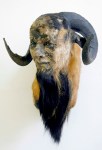
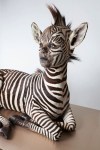
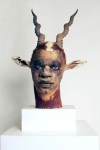
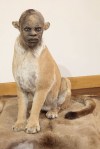
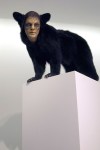
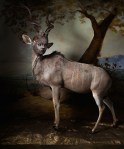
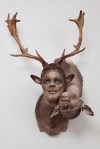
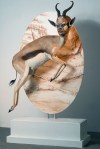
Kate Clark, in a studio near Brooklyn Navy Yard, houses a variety of strange taxidermies . The interesting thing about her animals is that they all have human faces which have been sculpted from clay. She then uses the animal’s own facial skin to cover the faces. Kate uses recycled hides that are considered imperfect for trophy mounts.
“In the Western World, humans are so separated that we have no reason to connect with [wild] animals anymore,” Kate says. “We have become so other.” In fact, she says that most people don’t even realize that she often changes the sex of the animals. Going through her sculptures you will see female faces with antlers attached—an appendage usually sported only by male animals. “Something as straightforward as that doesn’t even register, because our understanding of the natural world isn’t very good anymore,” she says. SOURCE
Faig Ahmed Creates Psychedelic Rugs From Traditional Azerbaijani Textiles
Faig Ahmed’s latest project focuses on making contemporary carpets from classical Azerbaijani textiles. Ahmed graduated from the Azerbaijan State Academy of Fine Art in Baku in 2004. His background as an artist covers painting, video and installation as well as other mediums; however, his attention is currently focused on working with textile and sculpture.
Traditional Azerbaijani carpets rely heavily on geometric and symmetrical patterns, stemming from historical influence. The carpets are usually limited to be rectangular or square in shape. By dismantling the laws that govern the structure and pattern of these fabrics, Ahmed converges his love of ancient culture to create a psychedelic visualization. By refurbishing the traditional compositions into a contemporary sculpture, he disassembles their stable nature and injects motion into a pre-existing lifeless object.
The patterns break away from their rigid symmetry and melt away from the tapestry into a colorful puddle. Ahmed also adds a digital effect to the rugs by pixelating fragments and blank spaces on the drapery. Overall, the artist intentionally creates an interesting union between contemporary art and ancient Azerbaijani roots.







 if it happened at all, it happened like that